You have felt an instant, specific pull toward one particular person's presence, unrelated to anything they said. Not everyone gets that reaction from them. Something in your chart is answering something in theirs, and a channel is usually the mechanism behind it.
What a channel is, in one sentence
A channel is the line connecting two gates at either end of a bodygraph connection, and it only becomes real when both gates are switched on. Thirty-six of these lines exist, each joining two specific centers, and each carrying a distinct quality that is more than either gate would produce alone.
Why both gates matter
A gate on its own, with no matching gate lit at the other end of its line, is what Human Design calls a hanging gate. The theme is present. The center it belongs to still shows whatever that gate contributes. But the connection is not wired through, and the energy behaves inconsistently rather than reliably.
A defined channel is different. Both gates are lit, the line fills in, and both centers it joins become defined as a result. This is the single most common confusion beginners bring to a chart: treating an activated gate as though it were a complete channel. It is not. One gate is a theme you carry. A full channel is a fixed, always-on wiring between two centers.
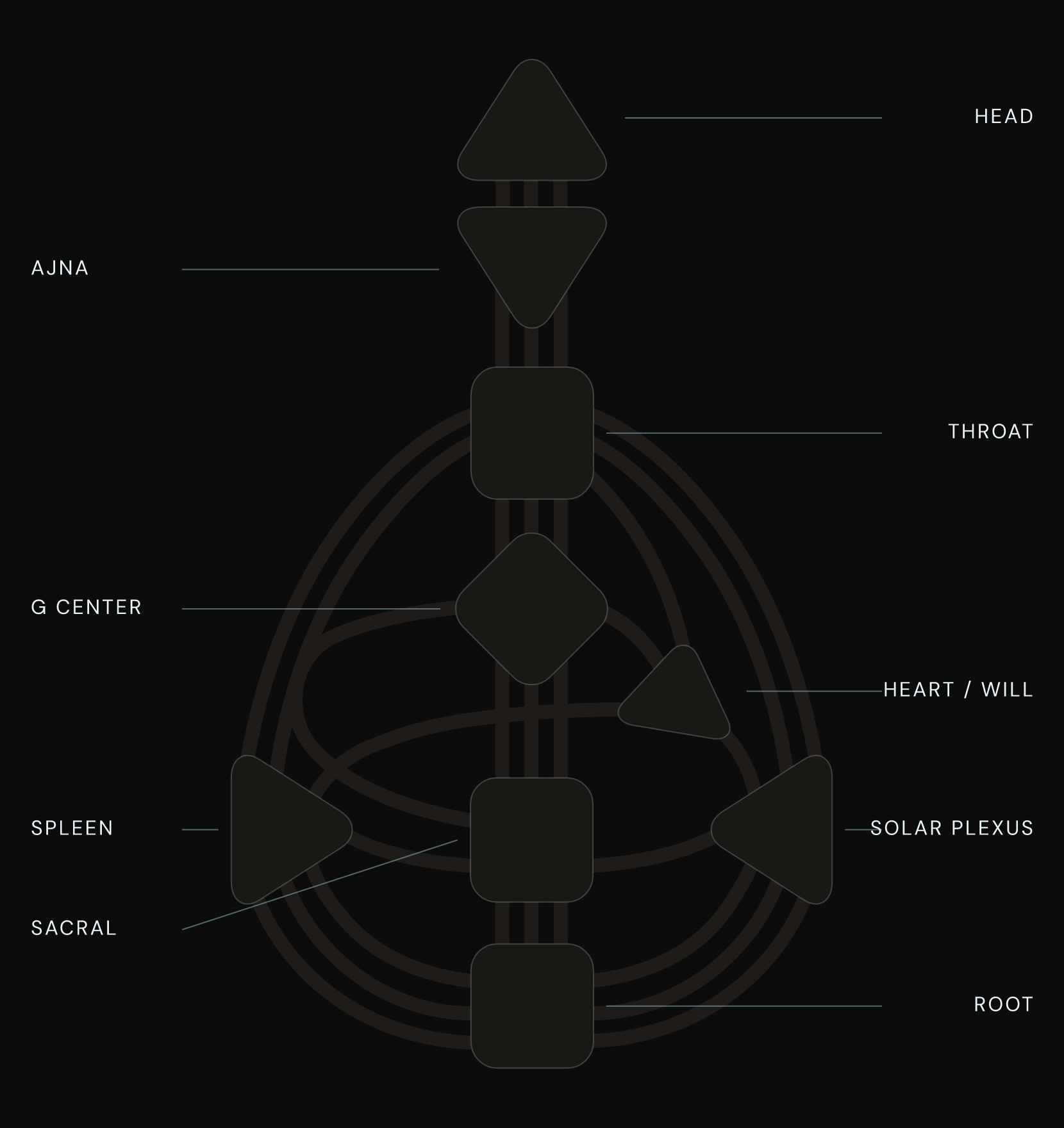
Generate your free chart and look for the lines drawn solidly between your centers. Those solid lines are your defined channels. Free to start. Your personal chart in about ten seconds.
The three circuit families
Every channel belongs to one of three circuit groups, and the group tells you what the energy is built to do with other people.
Collective channels are built to be shared broadly. They want to be shown, demonstrated, and included in a bigger picture, whether the theme is pattern recognition and improvement over time, or the felt wisdom of direct experience.
Individual channels cannot be forced onto anyone. They mutate and do their work through being witnessed rather than broadcast, which is why an Individual channel often feels like a signal meant for the right person at the right moment rather than for a crowd.
Tribal channels are specific and intimate. They govern the agreements, resources, and bonds that hold a close community together, and they tend to lose their charge entirely when aimed at strangers instead of the people they were built for.
Two people can each carry a channel that feels equally present in a chart, and behave in distinctly different ways depending on which of the three families it belongs to.
A short list of channels, and what they carry
The full set of 36 spans every combination of two connected centers, but a few illustrate the range clearly. The Sacral-to-G-Center channel of rhythm carries a natural flow with the pace of life. The Root-to-Solar-Plexus channel of recognition carries desire and feeling as the driver of experience. The Heart-to-Throat channel known as the sustained carries will and material resources, sometimes called the money line. The Spleen-to-Sacral channel of power carries intuitive strength that acts in the present moment rather than planning ahead.
Each of the 36 has its own name, its own pair of gates, and its own specific theme, all of it grounded in which two centers it joins and which circuit family it belongs to.
What changes when a channel completes between two people
Channels are not only read within one chart. When two charts are compared, every channel shows one of four patterns. In an electromagnetic pairing, each person holds one gate of the channel, and together they complete something neither has alone, which often reads as strong, immediate attraction. In a dominance pairing, one person carries the full channel and the other carries neither gate, so the defined person's theme quietly leads that part of the relationship. In a companionship pairing, both people already carry the same channel fully, which produces ease and familiarity rather than any new charge. In a compromise pairing, both people carry the same single hanging gate, sharing a longing that neither can complete for the other.
None of these patterns is better than the others. Each simply describes a different shape of connection, and recognizing which one is active explains a great deal about why a particular relationship feels the way it does.
The misdiagnosis: mistaking a theme for a wiring
A person who reads a single activated gate in their chart often assumes the full theme of that gate's channel applies to them consistently. It does not, not unless the matching gate is also lit. The correction matters in practice: a hanging gate is a genuine part of the design, a theme worth noticing, but the energy around it is thematic and situational rather than fixed. It tends to become active when someone carrying the harmonic gate enters the room, briefly completing the channel from the outside, which is one of the primary ways conditioning enters a chart.
Where channels fit in reading a chart
Channels are read after type, strategy, authority, profile, and the centers themselves, not before. The logic is sequential: type tells you the broadest frame, authority tells you how you decide, and centers tell you which parts of the design are fixed. Channels are where that structure gets specific, the actual wiring behind the fixed centers, and they are best read as core drives and capacities rather than as the starting point for understanding a chart.
Within the channels themselves, full definitions carry more weight than hanging gates. A person new to their chart benefits from scanning for solid, complete lines first, since those are the connections doing consistent work every day, before spending time on the gates that only light up in the right company.
Practical takeaway
When a chart shows a fully defined channel, the practice is to trust that theme as a fixed part of how the energy moves, present whether the room is full or empty. When a chart shows only a hanging gate, the practice is to notice the theme without expecting it to hold steady, since it activates more reliably around other people than from the inside alone.
How to start
- Get your chart. Generate your free chart and look for the solid lines connecting your centers. Each one is a defined channel.
- Check for hanging gates. A gate number with no line drawn to its partner is present but not wired through. The theme is yours; the consistency is not.
- Notice your circuit families. The chart details view groups your defined channels by Collective, Individual, and Tribal, which explains how each one is built to be used.
Frequently asked questions
What is a channel in Human Design?
A channel is the connection between two gates at either end of a line in the bodygraph. It becomes a defined channel only when both gates are activated, wiring the two centers it joins into a fixed, reliable connection. Thirty-six channels exist in total.
What is the difference between a channel and a gate?
A gate is a single point on the bodygraph, one of 64, activated by a planet's position at birth or in the design calculation. A channel is what forms when two connected gates are both activated. One gate alone is a theme. A completed channel is a fixed wiring between two centers.
What is a hanging gate?
A hanging gate is a single activated gate whose channel partner is not lit, so the connection is not wired through. The theme it carries is real but inconsistent, often becoming more active when someone carrying the matching gate is nearby, temporarily completing the channel from outside.
How many channels are there in Human Design?
Thirty-six. Each connects a specific pair of centers and belongs to one of three circuit families: Collective, Individual, or Tribal, which describes how that channel's energy is meant to move between people.
Do channels matter for relationships?
Yes. Comparing two charts shows how each shared or unshared channel behaves between two people: electromagnetic attraction when each person completes half, dominance when only one carries it, companionship when both already have it, and compromise when both carry the same unfinished half. Human Design for relationships covers this in full.
Previous: The Reflector: The Rare Mirror, and the Lunar Cycle. Next in the series: Gates: The 64 Specific Qualities You Carry.