You have opened a full chart, seen every shape, number, and line at once, and closed it again without knowing where to start. That reaction is common, and it says nothing about the chart being too complex to learn. It says the chart was read out of order. There is a specific sequence that makes it make sense, and almost nothing on this page requires anything you have not already met in the rest of this series.
The order matters more than any single layer
A Human Design chart holds eight distinct layers, and reading them out of sequence is the single biggest reason beginners find a chart overwhelming. Type comes first because it sets the broadest frame. Strategy and authority follow because they are the layers a person can act on immediately. Profile, definition, centers, channels, and gates fill in increasing detail, each one meaningful mainly in light of what came before it. The Incarnation Cross sits last, the broadest context of all, and it is the layer most safely read once everything beneath it is already understood.
Generate your free chart and follow along with your own layers as this walkthrough goes through them in order. Free to start. Your personal chart in about ten seconds.
1. Type: the broadest frame
Type describes how a person's energy meets the world and, from that, the single best way to move through decisions. There are five: Generator, Manifesting Generator, Projector, Manifestor, and Reflector, and everything else in a chart is detail hung on this frame. The five types is the place to start if type is still unfamiliar.
2. Strategy: the correct movement
Strategy follows directly from type: respond for a Generator or Manifesting Generator, wait for the invitation for a Projector, inform for a Manifestor, wait a lunar cycle for a Reflector. Strategy and authority covers the full mechanic, and this is the first layer a person can put into practice the same day they learn it.
3. Authority: how the decision gets made
Authority names the specific mechanism a chart uses to decide, distinct from strategy, which names how a person engages with the world in the first place. Sacral, emotional, splenic, ego, self-projected, mental, or lunar, each authority runs on a different signal and a different timeline, and finding the right one on a chart is what turns strategy from a concept into something usable on a real decision.
4. Profile: the life's geometry
Profile is a two-line combination, personality line over design line, describing a life's learning style and the broader shape it moves through rather than a fixed personality trait. Your profile covers all twelve combinations and what each one tends to mean in practice.
5. Definition: how the defined centers connect
Definition describes whether a chart's defined centers form one connected group or split into two, three, or four separate groups, each gap a place another person's presence can temporarily bridge. Definition covers single, split, triple split, and quadruple split in full, and it is worth reading before centers, since it explains why some centers work together as a single system and others do not.
6. Centers: what is fixed, and what is open
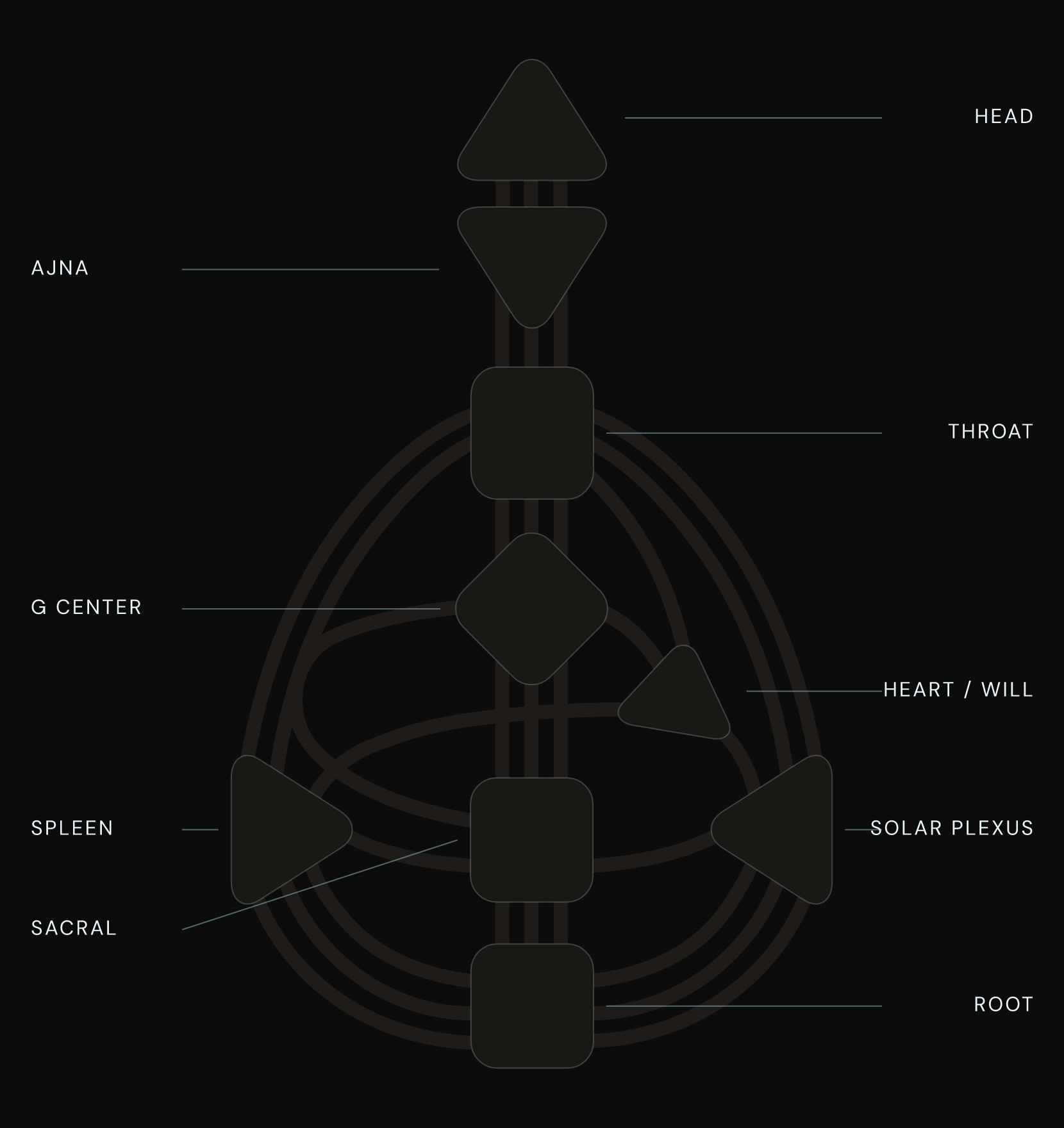
Every chart has nine centers, and each one is either defined, colored in and consistent, or open, white and receptive to whatever the surrounding defined centers are broadcasting. The nine centers and open and undefined centers cover both halves of this layer, and together they explain most of the day-to-day texture of a chart: which parts of a person are reliably fixed, and which parts take on the shape of whoever is in the room.
7. Channels and gates: the specific wiring
Channels are the completed lines between two centers, formed only when both connecting gates are activated. A gate on its own, without its partner lit, is a hanging gate: a genuine theme, but not a fixed, always-on part of the design. This is the finest-grained layer worth reading in detail, and it rewards attention only once type, strategy, authority, profile, definition, and centers are already clear, since a gate or channel's meaning depends heavily on the center it belongs to and whether it forms a complete connection.
8. The Incarnation Cross: the widest context
The Incarnation Cross is drawn from four specific Sun and Earth gate positions across a chart's two birth moments, and it describes the broadest life direction and context a person is moving through, not a task list or an instruction. It is read last because it only holds together once every layer beneath it, type through channels, is already in view. A Cross read in isolation, before the rest of the chart is understood, tends to produce vague or overreaching interpretations that the mechanical layers underneath do not support.
The misdiagnosis: trying to read everything at once
A beginner who opens a full chart and tries to absorb every gate, channel, and center simultaneously usually walks away with an impression rather than an understanding. The chart was never meant to be read all at once. It is meant to be read in the sequence above, each layer making the next one legible, and skipping ahead to gates and channels before type and authority are settled is the most common way a chart starts to feel unreadable.
Reading someone else's chart the same way
The same order applies when reading a chart other than your own, with one caution worth naming directly. Common misreadings in practitioner work include treating an open center as a weakness rather than a place of potential wisdom, mistaking a single activated gate for a complete channel, giving the mind authority it does not have by asking someone to "think about" what resonates, treating profile as a fixed personality description rather than a learning style, and making the Incarnation Cross prescriptive rather than contextual. Reading in order, and staying honest about which layer is speaking, avoids most of these on its own.
Practical takeaway
When a chart feels like too much at once, the practice is to work through it in order rather than scanning for whichever detail looks most interesting first. Type, then strategy, then authority, then profile, then definition, then centers, then channels and gates, then the Cross. Each layer earns the next.
How to start
- Get your chart. Generate your free chart and open the chart details view alongside this walkthrough.
- Confirm the first three layers before anything else. Type, strategy, and authority are the foundation everything else sits on.
- Print your one-sheet. A single page with type, strategy, authority, and profile is easier to reference against real decisions than scrolling back through a full chart each time.
Frequently asked questions
What order should I read my Human Design chart in?
Type first, then strategy and authority, then profile, then definition, then centers, then channels and gates, then the Incarnation Cross last. Each layer builds on the one before it, and reading out of order is the most common reason a chart feels overwhelming to a beginner.
What should I look at first on my chart?
Type. It sets the broadest frame for everything else on the chart, including which strategy applies and which authority mechanisms are even possible for that type. Strategy and authority follow immediately after, since they are the first layers a person can act on.
Do I need to understand gates and channels to use my chart?
No. Type, strategy, and authority are enough to begin living differently the same day they are learned. Gates and channels are a finer layer that rewards attention once the foundational layers are clear, not a prerequisite for using the basics.
What is the Incarnation Cross, and why is it read last?
The Incarnation Cross is drawn from four Sun and Earth gate positions and describes the broadest life direction a person is moving through. It is read last because it only makes sense in light of everything beneath it, and reading it before type, strategy, and authority are settled tends to produce vague or overreaching conclusions.
How long does it take to learn to read a chart?
Type, strategy, and authority can be understood and put into practice within a single sitting. The full sequence through channels and gates takes longer, and the finer layers are meant to deepen over time rather than being absorbed all at once. Is Human Design real? covers how to test what you learn against your own experience as you go.
Previous: Human Design for Relationships: How Two Charts Connect. Next in the series: Is Human Design Real? An Honest Look, and How to Test It Yourself.