You have caught yourself certain about something, only to notice the certainty evaporated the moment you left the room it arrived in. That was not a change of mind. It was likely an open center picking up someone else's energy, holding it as though it were yours, and then releasing it the moment their presence was gone.
What conditioning is, in one sentence
Conditioning is the process by which a person's open centers absorb the energy of the defined centers around them, from parents and peers in childhood onward, until the mind mistakes that borrowed energy for a genuine, permanent part of who they are.
Why open centers are where it happens
A defined center runs the same way regardless of who is present. It is fixed, and other people can feel it coming off a person reliably. An open center is different. It has no fixed setting of its own, so it takes in whatever the surrounding defined centers are broadcasting and amplifies it, often past the original intensity.
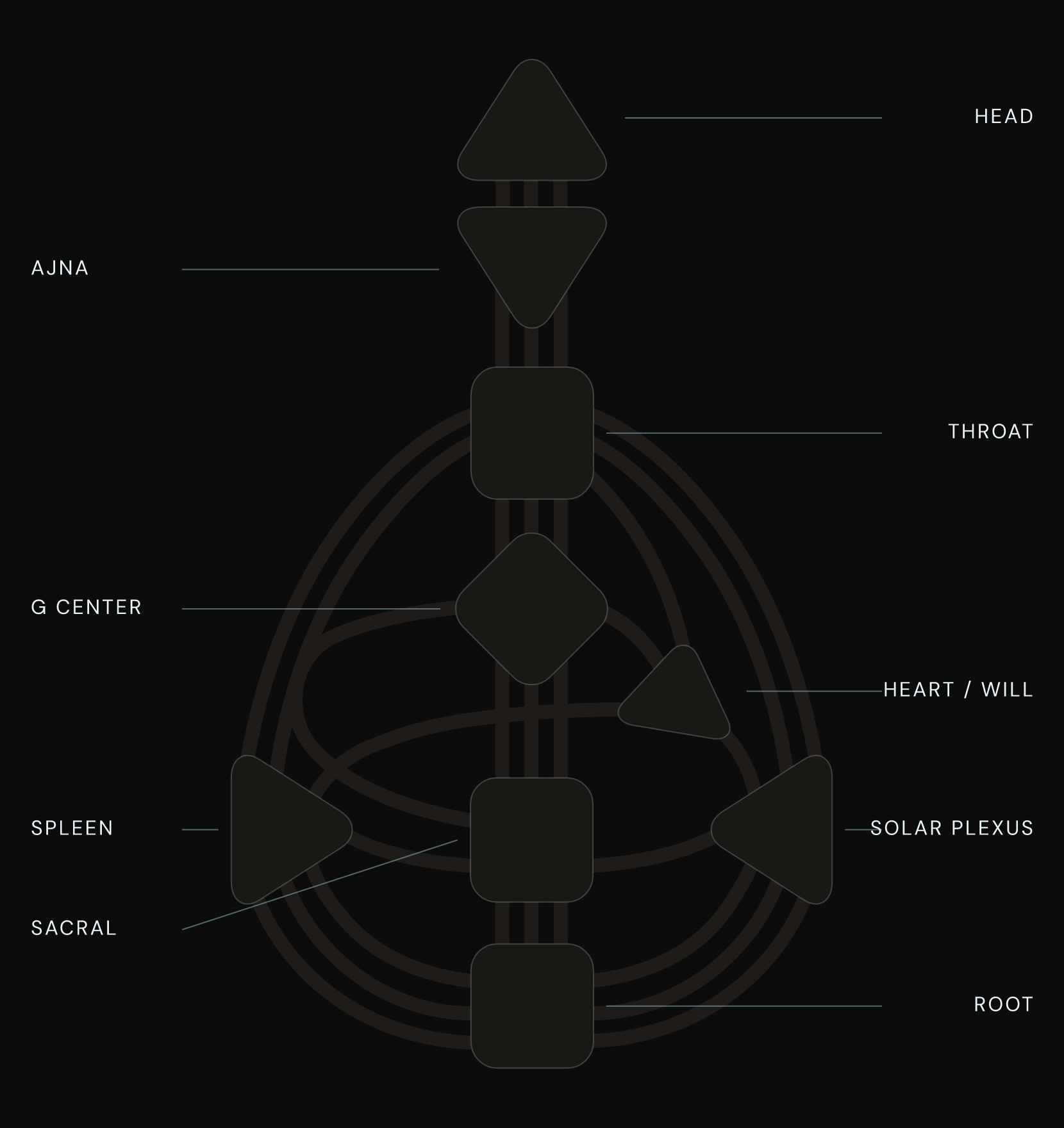
From birth, every open center in a chart is exposed to this. A child with an open Solar Plexus absorbs the emotional weather of the household long before developing any emotional signal of their own. A child with an open Sacral absorbs the work ethic, or the exhaustion, running through whoever has a defined Sacral nearby. None of this is a flaw in the design. It is exactly how an open center is built to function. The trouble begins later, when the absorbed pattern gets mistaken for identity.
Generate your free chart to see which of your own centers are open, since those are the specific places conditioning has had the most access. Free to start. Your personal chart in about ten seconds.
The not-self mind
The mind is the primary vehicle carrying conditioning forward. Each open center produces its own recurring inner question, a kind of background monologue that keeps the absorbed pattern in place. An open Head can spend years trying to answer questions that were never its own to solve. An open Ajna can chase certainty it was never built to hold. An open Throat can search for ways to be noticed. An open Sacral can struggle to recognize when enough work is enough.
None of these patterns announces itself as foreign. They sound exactly like a person's own thoughts, which is the entire mechanism keeping conditioning invisible. The practice is not arguing with the question when it arises. It is recognizing the pattern as the not-self mind rather than as truth, and returning attention to the body's actual signal instead of following the thought further.
The misdiagnosis: an open center is not a flaw
An open center is routinely read as a weakness, evidence of not having enough energy, resolve, or emotional stability in that area of life. The mechanic says the opposite. An open center is a place of genuine wisdom once the absorbed energy stops being mistaken for identity, because it has sampled that energy in countless configurations and can read it in other people with real accuracy. The deficiency was never in the center. It was in the identification.
What conditioning looks like from the outside
A person whose open Sacral has absorbed a household's relentless work ethic can spend years pushing through exhaustion that was never their engine to run on, and call the resulting collapse a personal failing. A person whose open Solar Plexus has absorbed a volatile emotional environment can avoid every form of confrontation, mistaking that avoidance for their own temperament rather than a strategy built to survive someone else's weather.
In both cases, the pattern feels entirely personal. Tracing it back to a specific open center, and to the environment it was shaped in, is usually the first moment the pattern becomes visible enough to work with.
Practical takeaway
When a strong opinion, urgency, or emotional certainty arrives, the practice is to check whether it is standing on a defined center or an open one. An open center's signal shifts depending on who is in the room. A defined center's signal holds steady whether anyone else is present or not.
How to start
- Get your chart. Generate your free chart and see exactly which centers are open in your own design.
- Notice the not-self questions. Each open center has a typical inner monologue attached to it, worth learning so it can be recognized when it arises.
- Track one pattern back to its source. Pick a recurring feeling that seems personal, and ask which open center it might be running through, and whose energy it originally belonged to.
Frequently asked questions
What does conditioning mean in Human Design?
Conditioning is the process by which open centers absorb the energy of the defined centers around them, starting in childhood, until the mind mistakes that absorbed energy for a fixed, personal trait rather than something taken in from the environment.
Why do open centers get conditioned and not defined ones?
A defined center runs the same way regardless of who is present, so there is nothing inconsistent for it to absorb. An open center has no fixed setting of its own, which means it takes in and amplifies whatever the surrounding defined centers are broadcasting.
What is the not-self mind?
The not-self mind is the recurring inner monologue produced by each open center, a specific question or pattern that keeps conditioning in place by sounding exactly like a person's own genuine thoughts. Recognizing it as a pattern, rather than as truth, is the first step in loosening its hold.
Is having open centers a bad thing?
No. An open center is not a flaw or a deficiency. It becomes a source of real wisdom once the absorbed energy stops being mistaken for identity, because it has sampled that energy across countless people and situations and can read it with genuine accuracy in others.
How do I know which of my centers are conditioned?
Any open center on a chart is a place where conditioning has had access since childhood. Generate your free chart to see which of your centers are open, then notice which patterns in daily life shift depending on who is in the room, a reliable sign of conditioning at work.
Previous: Definition: How Your Energy Connects. Next in the series: Deconditioning: The Experiment That Makes It Real.