Sarah is scrolling at eleven at night. A reel stops her: a woman saying that if you keep saying yes to things your body already said no to, what you are calling tiredness is not tiredness. It is frustration. Sarah watches it twice. She is a Generator, and she recognizes her own last two years.
You have probably made that yes. The sensible job. The favor you agreed to while something below your ribs went flat. Then the long grind of doing it anyway.
What Human Design is, in one sentence
Human Design is a map of how your energy is built to work. Drawn from your birth date, time, and place, it describes how you are wired to decide, where your energy is reliable, and where you absorb everyone else's.
A map, not a horoscope.
The distinction matters because of what a map is for. It does not tell you what happens next. It tells you the terrain, and then it sends you out to walk on the ground and check whether the drawing was right. Nothing in this system asks for belief. It asks for an experiment: read what the chart says about how you are built, run it against your own week, and keep the parts that hold.
Where the chart comes from
Your chart is built from two moments, not one.
The first is your birth: the exact date, time, and place. Human Design calls this the Personality. It is the layer you can see in yourself, the part you would describe if someone asked what you are like.
The second moment sits before you were born. Human Design goes back to the point where the Sun had travelled about 88 degrees of arc less than it had at your birth, which works out to roughly three months earlier. This is the Design layer. It is the part other people notice about you long before you notice it yourself: the way you move, the way you take up a room, the things you do without deciding to.
Both layers are labelled on your chart, and each activation is colored by which one switched it on. Most Human Design sites print Personality in black and Design in red. Aquarius Design uses cyan for Personality and white for Design, on a near-black chart, because the two read more clearly side by side that way. The mechanic is identical whichever palette you meet it in.
Two snapshots. One you know about, one you mostly do not. Both get mapped onto the same diagram.
The system that reads those snapshots is a synthesis. It takes the 64 hexagrams of the I Ching and turns them into the numbered gates of the chart. It takes the Tree of Life from Kabbalah and turns it into the lines running between centers. It takes the chakra system and maps it into the nine centers of the chart. And it takes the planetary calculation from astrology, which is where your birth data comes in. Ra Uru Hu, born Alan Krakower in Montreal in 1948, assembled it after an eight-day encounter on Ibiza in January 1987 with what he described as the Voice. He said the whole system arrived in those eight days. He taught it for the next twenty-four years and died in 2011.
The origin story is not the part you have to make a decision about. The calculation underneath it is ordinary astronomy: the same planetary positions an observatory publishes, run to under an arcminute. Put in a date, a time, and a city, and the diagram that comes back is fixed. What you make of the diagram is where your part starts.
Generate your free chart and keep it open beside this page. Everything below is easier to follow with your own diagram in front of you. Free to start. Your personal chart in about ten seconds.
What the bodygraph shows
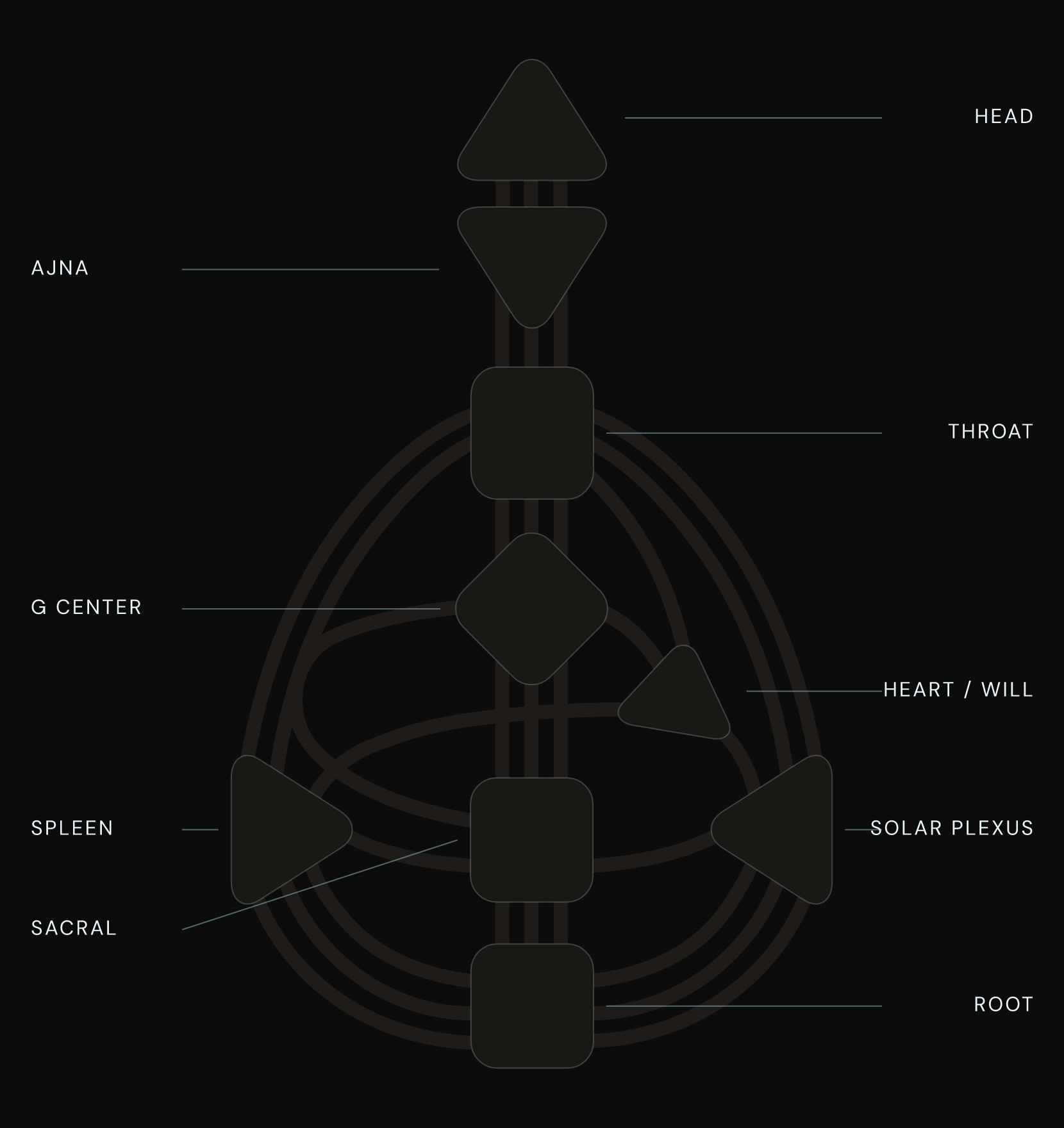
Open your chart and you meet a body-shaped figure of nine geometric shapes, joined by lines, scattered with numbers. That figure is the bodygraph. Here is what its parts are for.
The nine centers
Each shape is a center, and each one governs a specific function. The Head is the pressure to think, the questions that will not leave you alone. The Ajna turns that pressure into opinions and frameworks. The Throat is where everything seeks expression. The G Center holds identity, love, and direction. The Heart is willpower and the promises you can keep. The Solar Plexus is the emotional wave that moves between hope and pain. The Sacral is life force, the engine that either fires for work or does not. The Spleen is instinct, the thing that knows in the moment whether something is good for you. The Root is adrenaline and the pressure to get moving.
Some of your centers are colored in. Some are white. That single difference does more explanatory work than anything else on the page.
A defined center, colored in, runs the same way all the time. It is fixed. It is yours whether the room is full or empty, and other people can feel it coming off you consistently enough to rely on it.
An open center, white, is not fixed. It takes in whatever the people around you are running through that same center and amplifies it. This is why certain rooms flatten you and certain people leave you buzzing on someone else's energy for hours afterwards. An open center is not a deficiency. It is where you are most easily conditioned in the short run and most capable of real wisdom in the long run, because you have sampled that energy in a thousand versions and can read it in anyone.
If you have ever left a party carrying an urgency that was not yours when you arrived, you have felt an open center working.
Channels and gates
The numbers scattered around the bodygraph are gates, sixty-four of them, one for each I Ching hexagram. Each gate sits in a specific center and gets switched on by where a planet was in one of your two snapshots.
A channel is what happens when both gates at either end of a line get switched on. The line fills in, and the two centers it joins are both defined. Thirty-six of these channels exist. A gate on its own, with nothing answering it at the other end, is a hanging gate: the theme is present, but it is not wired into anything.
This is the fine wiring. It rewards attention once the basics are in place, and it will bury you if you start there. Leave it. How to read your bodygraph takes the whole diagram apart piece by piece when you want it.
Type is the one thing to learn first
If you take one thing from this page, take your type.
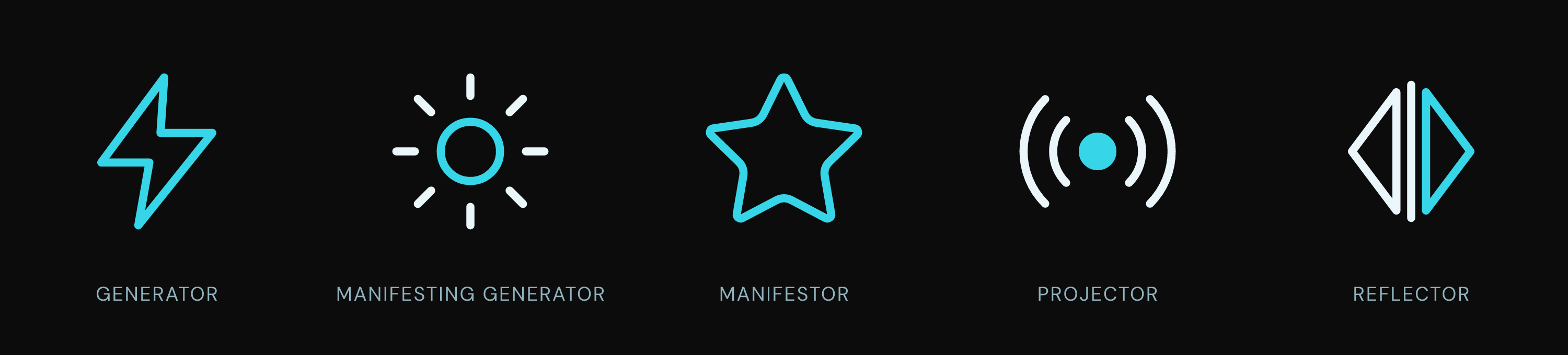
Type describes how your energy meets the world, and from that, the single best way for you to move through decisions. Everything else in the chart is detail hung on this frame. There are five types, and they are not evenly distributed.
| Type | Share of people | The move |
|---|---|---|
| Generator | about 37% | Respond to what shows up, then follow the gut yes |
| Manifesting Generator | about a third | Respond, then tell people before you move |
| Projector | about one in five | Build mastery, stay visible, wait for real recognition |
| Manifestor | about one in ten | Inform the people affected, then act |
| Reflector | about one in a hundred | Let a decision sit through a full lunar cycle |
Generators have a defined gut center, what Human Design calls the Sacral. They carry renewable energy for work they genuinely want, and their aura is open and enveloping: it draws people, offers, and problems toward them without any effort. That is the whole difficulty. A Generator is never short of things to say yes to. The skill is being selective about which ones get the yes.
Manifesting Generators are Generators with a faster route from that engine to the Throat. Same open aura, same gut yes, one extra step: tell the people who will be affected before you move, because you move quickly and leave people behind.
Projectors have no defined Sacral engine and are not built for constant output. Their aura is focused and penetrating: it reaches into other people and reads them at unusual depth. That gift lands as guidance when it is invited and as intrusion when it is not, which is why recognition matters so much to them. A Projector running a Generator's schedule burns out and calls it a personal failing.
Manifestors are the only type built to start things without waiting for anything. Their aura is closed and repelling, so people feel the impact before a word is said, and they respond by trying to control what they cannot predict. Informing the people affected, before acting, is what clears that resistance.
Reflectors have no defined centers at all. Nothing in them is fixed, which makes them accurate barometers of whatever community they are standing in and means a decision needs a full lunar cycle, about 29.5 days, before it is trustworthy.
Your chart names your type at the top of the summary. The five types guide is the next thing to read after this page.
Your body answers before your mind does
Back to the reel that stopped Sarah, because it named the most common experience in this entire system.
Roughly 65 to 70% of people have a defined Sacral: Generators and Manifesting Generators together. If you are one of them, your gut produces a real yes and a real no, and it produces them before your reasoning starts. It is not a feeling you cultivate. It is closer to a sound than a thought: a rising warmth and an involuntary "mm-hmm" for yes, a flat or contracting quality and an "unh-uh" for no.
Most people override it. Somebody asks, the gut goes flat, and the mind arrives half a second later with an excellent argument for saying yes anyway. It is a good opportunity. It would be rude to decline. It is only six months.
Then comes the grind. And here is the part worth carrying: frustration is diagnostic. It is not a character flaw, it is not proof you are lazy, and it is not a sign you need more discipline. It is the reading on an instrument. It points at commitments entered through mental decision rather than gut response, and it keeps pointing until something changes.
It reads the same way in reverse. When a Generator is engaged in work the body genuinely responded to, the day ends with something spent but nothing wasted. Tired, yes. Depleted, no. Those are different sensations and you already know which one you have been having.
The signal is not the same for everyone. Where your reliable yes lives depends on your authority, which is the mechanism your chart hands you for making decisions, and for about half of people it runs on emotional timing rather than a gut hit. Strategy and authority is the guide for that.
The honest test
Human Design is not a proven science. There is no body of controlled research behind it, and no peer-reviewed literature establishing that the chart predicts anything. Aquarius Design does not claim otherwise, and does not need to.
What can be said precisely is narrower and more useful. The astronomy is exact: planetary positions calculated to under an arcminute, the same data any observatory would give you. The framework built on top of that data is a system of self-knowledge, and the only test available to you is the one you can run yourself.
That test is straightforward. Read what your chart says about how you make decisions and where your energy is reliable. Then watch your own week against it. Notice the decisions you made from the head and how they turned out. Notice the ones the body picked. If the description keeps matching what you find, it is doing its job. If it does not, discard it. A framework that cannot survive contact with your actual life has not earned a place in it.
Learn one mechanic and put it under load. That is the whole beginner move. Is Human Design real? goes further into what can and cannot be claimed.
Practical takeaway
When something arrives that wants a decision from you, pause before the reasoning starts. The check is simple: what did the body do in the first second, before the list of pros and cons assembled itself? That first movement is the signal. The argument you build on top of it afterwards is not.
How to start
Three steps, and none of them require you to believe anything.
- Get your chart. Generate your free chart from your birth date, time, and place. You will see your bodygraph, and at the top: your type, your strategy, which is the one move that works for that type, and your authority, which is where your reliable yes lives.
- Read your type. Find it on the summary, then read the five types guide for what yours means in practice.
- Run one decision through it. Take a real choice, apply your type's move, and notice what your body reports rather than what your head concludes.
The app does the mechanical work: it calculates the chart, renders a clean bodygraph, and explains every part of it in language you can use. What it cannot do is bring your week to it. That part is yours.
Sarah did not get an answer from that reel. She got a better question, and it is the one this whole map is built to help you ask: which of my yeses were ever mine?
Frequently asked questions
Is there any science behind Human Design?
No, not in the sense of controlled studies or peer-reviewed evidence. The planetary calculation is real astronomy, accurate to under an arcminute, but what the system builds on top of that has not been tested scientifically and this practice does not claim it has. Treat it as a framework for self-knowledge and judge it by whether it matches your experience. Is Human Design real? covers this honestly.
Do I need my exact birth time?
For a fully accurate chart, yes. Your type, your authority, and your profile, the two-number pair describing how you engage with people, can all shift with the time of day, so the time on your birth certificate gives you the truest version. Without it you can still generate a chart and get real value from the broader structure, but treat anything time-sensitive as provisional until you can confirm the hour.
How is Human Design different from astrology?
They start from the same raw material, planetary positions at your birth, and then do different things with it. Astrology interprets the planets and signs directly. Human Design routes those positions through a second calculation before birth and onto the bodygraph, producing a mechanical description of how your energy and decision-making are wired. Read Human Design and astrology for the full comparison.
Where do I get my chart?
Enter your birth date, exact time, and city into a chart calculator. You can generate your free chart here in about ten seconds and it stays yours. If the exact time is missing, generate one anyway and treat the time-sensitive parts as provisional until you find it.
What are the five types?
Generator, Manifesting Generator, Projector, Manifestor, and Reflector. Generators and Manifesting Generators are roughly two-thirds of people and run on a gut response. Projectors are about one in five and work through recognition. Manifestors are about one in ten and initiate. Reflectors are about one in a hundred and decide across a lunar cycle. Full detail in the five types guide.
Next in the series: The Five Human Design Types (and How to Find Yours).