You look at your chart and see a scatter of numbers between one and sixty-four, sitting inside shapes you can identify but with no obvious meaning attached to the digits themselves. The numbers are not decoration. Each one is a gate, and each gate is a specific, checkable piece of how you are built.
What a gate is, in one sentence
A gate is one of 64 points on the bodygraph, each tied to one of the 64 hexagrams of the I Ching, and switched on by the position of the Sun, Moon, or a planet at the moment of birth or at the earlier design calculation. Every gate belongs to a specific center, and every gate has at least one channel partner, the matching gate at the other end of a line, that would complete a defined channel if it were also activated.
Where the numbers come from
The gates are not arbitrary labels. They are the direct translation of the I Ching's 64 hexagrams into the bodygraph, one of the four traditions Human Design synthesizes into a single chart. A gate's number tells you which hexagram it descends from, which center it sits inside, and which other gate would complete its channel.
Because a gate is activated by an exact planetary position, most people carry a distinctive mix: some gates with their channel partner also lit, forming complete channels, and others standing alone as hanging gates, present as a theme without the consistency a full channel provides.
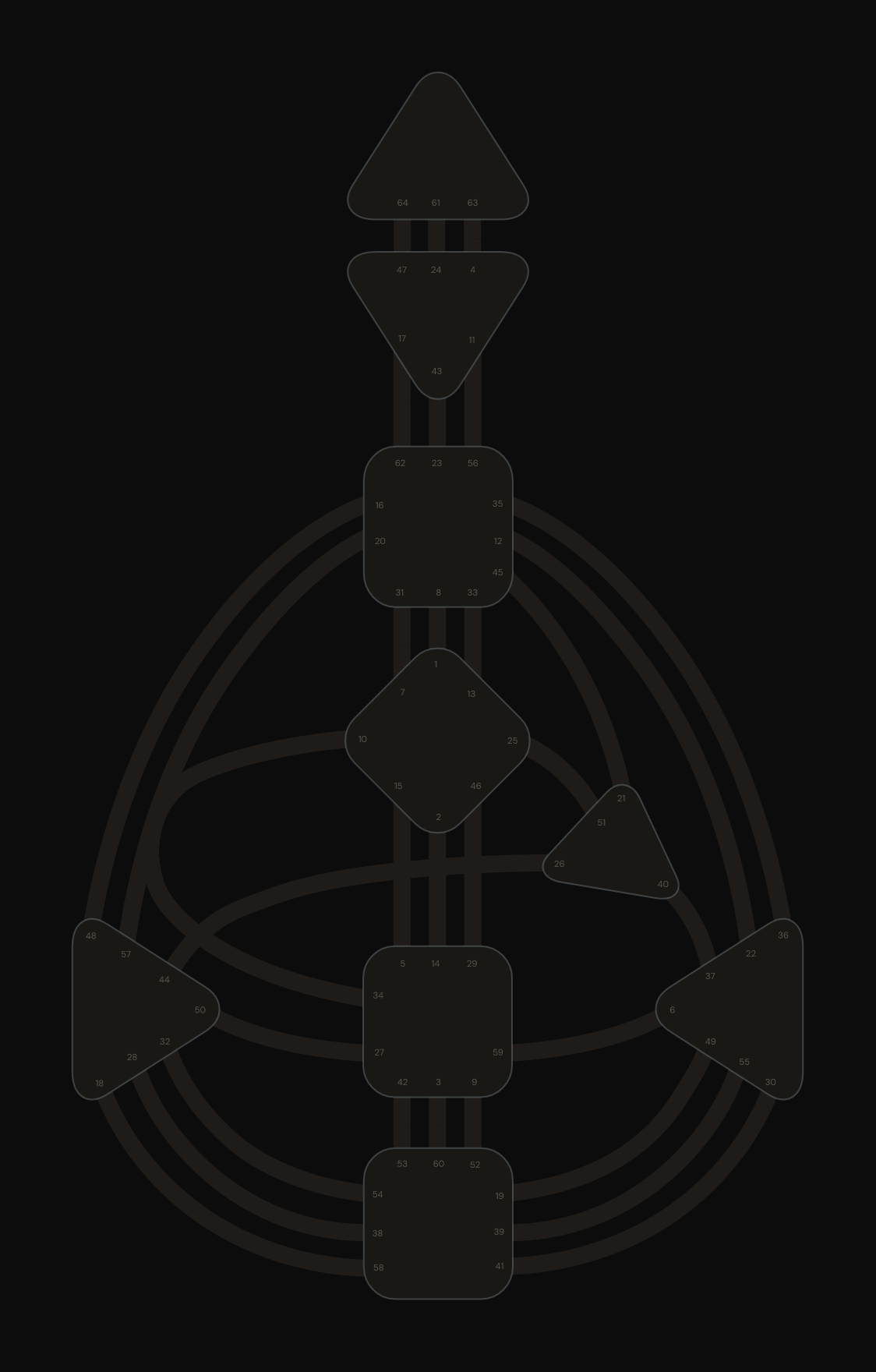
Generate your free chart to see your own gate numbers laid out on the bodygraph. Free to start. Your personal chart in about ten seconds.
The six lines inside every gate
Every gate carries six lines, sub-expressions of the same underlying theme, and the specific line active in a chart comes from the exact degree the activating planet held at birth. Two people with the same gate activated can express it through noticeably different lines, which is part of why chart reading goes beyond simply listing which gates are present.
Line detail is a layer for later study. The more useful early habit is noticing which gates repeat across a chart's channels and which stand alone, before working through the finer distinction of which line of each gate is active.
Hanging gates, and what they are not
A hanging gate is a gate with no matching partner lit at the other end of its line. The theme it carries is genuine. It is not, however, a fixed, always-on part of the design the way a completed channel is. A hanging gate tends to come alive around people who happen to carry its missing half, briefly completing the channel from outside for as long as that person is present.
The common misreading treats a hanging gate as though it behaved exactly like a defined channel. It does not. A defined channel runs the same regardless of who is in the room. A hanging gate is thematic and situational, present as potential rather than as something reliably running on its own.
The Gene Keys layer
Every gate also carries a Gene Keys reading, a separate framework built by Richard Rudd on the same 64 hexagrams, describing each number through a Shadow, a Gift, and a Light: a lower, contracted expression, a working middle expression, and a higher, more spacious one. The Gene Keys layer is not part of Ra Uru Hu's original Human Design teaching. It is a distinct synthesis that shares the same numerical foundation, and Aquarius Design surfaces it inline alongside the standard gate content so a reader can see both readings of the same number in one place.
The misdiagnosis: a gate is not a personality trait
A gate is frequently treated the way a horoscope trait is treated, a fixed descriptor of character. That framing misses the mechanic. A gate is a location and an activation, not a verdict. What it means in practice depends on whether its channel is complete, which line is active, and which center the gate sits inside. Reading a single gate number as a complete description of a person skips most of what determines how that gate shows up.
Practical takeaway
When a gate appears on a chart, the practice is to check its channel partner before drawing a conclusion. A gate with its partner also lit is a fixed part of the design, present regardless of company. A gate standing alone is a real theme, worth noticing, but one that surfaces more reliably around certain other people than from the inside alone.
How to start
- Get your chart. Generate your free chart and look at the numbers inside your defined centers.
- Check which gates form full channels. A gate with its partner also lit forms a complete channel. One without a lit partner is a hanging gate.
- Read the Gene Keys layer for a gate that stands out. The Shadow, Gift, and Light on any gate number gives a second, complementary read on the same theme.
Frequently asked questions
What are gates in Human Design?
Gates are the 64 numbered points on the bodygraph, each tied to one of the 64 I Ching hexagrams and switched on by a planet's position at birth or at the design calculation. Each gate sits inside a specific center and has at least one channel partner that would complete a defined connection if it were also lit.
How many gates are there in Human Design?
There are 64 gates in total, matching the 64 hexagrams of the I Ching. Each person's chart activates a specific subset of them, based on the exact planetary positions at their two birth moments.
What is a hanging gate?
A hanging gate is an activated gate whose channel partner is not lit, so the connection is present as a theme but not wired into a fixed channel. It tends to become more active around people who carry the missing gate, temporarily completing the connection from outside.
What is the Gene Keys layer on a gate?
Gene Keys is a separate framework, developed by Richard Rudd, built on the same 64 hexagrams as Human Design. Each number carries a Shadow, Gift, and Light, a lower, middle, and higher expression of the same theme, offering a complementary reading alongside the standard gate content.
Do the lines inside a gate matter?
Yes. Every gate has six lines, and the specific line active in a chart depends on the exact degree the activating planet held at birth. Two people with the same gate can express noticeably different lines, which is a finer layer worth exploring once the gate and channel basics are clear.
Previous: Channels: The Flow Lines That Power Your Chart. Next in the series: Definition: How Your Energy Connects.