Your eyes slide straight past the diagram to the text below it, every time you open your chart. You know your type. You have run your strategy and authority through a real week of decisions. But the diagram itself, the body-shaped figure covered in triangles, squares, small numbers, and two columns down the sides, still reads like an electrician's schematic of a stranger.
Nobody ever walked you through it. That is the whole problem, and it is fixable in one read.
This guide names every part of the bodygraph in plain language: the nine centers, the channels, the gates, the two columns of numbers, and what the colors mean. By the end, you can open your own chart and know exactly what you are looking at.
One skeleton, switched on differently
The bodygraph is the body-shaped diagram at the heart of your chart. Here is the most useful thing to know about it, and the reason it is less overwhelming than it looks: every bodygraph on earth has the same skeleton. Nine geometric shapes. Thirty-six connecting lines. Sixty-four numbered positions. Yours, your mother's, your manager's, all drawn on the identical frame.
What makes your chart yours is which parts are switched on. Your birth data activates some of those numbered positions and leaves the rest dormant, colors some shapes in and leaves others white.
So reading a bodygraph is two small skills, not one big one. Learn the fixed skeleton once. Then see what is live in yours. This article teaches both, and it lands faster with your own chart open beside it. Open your real bodygraph in a second tab and read on.
Start with the nine centers
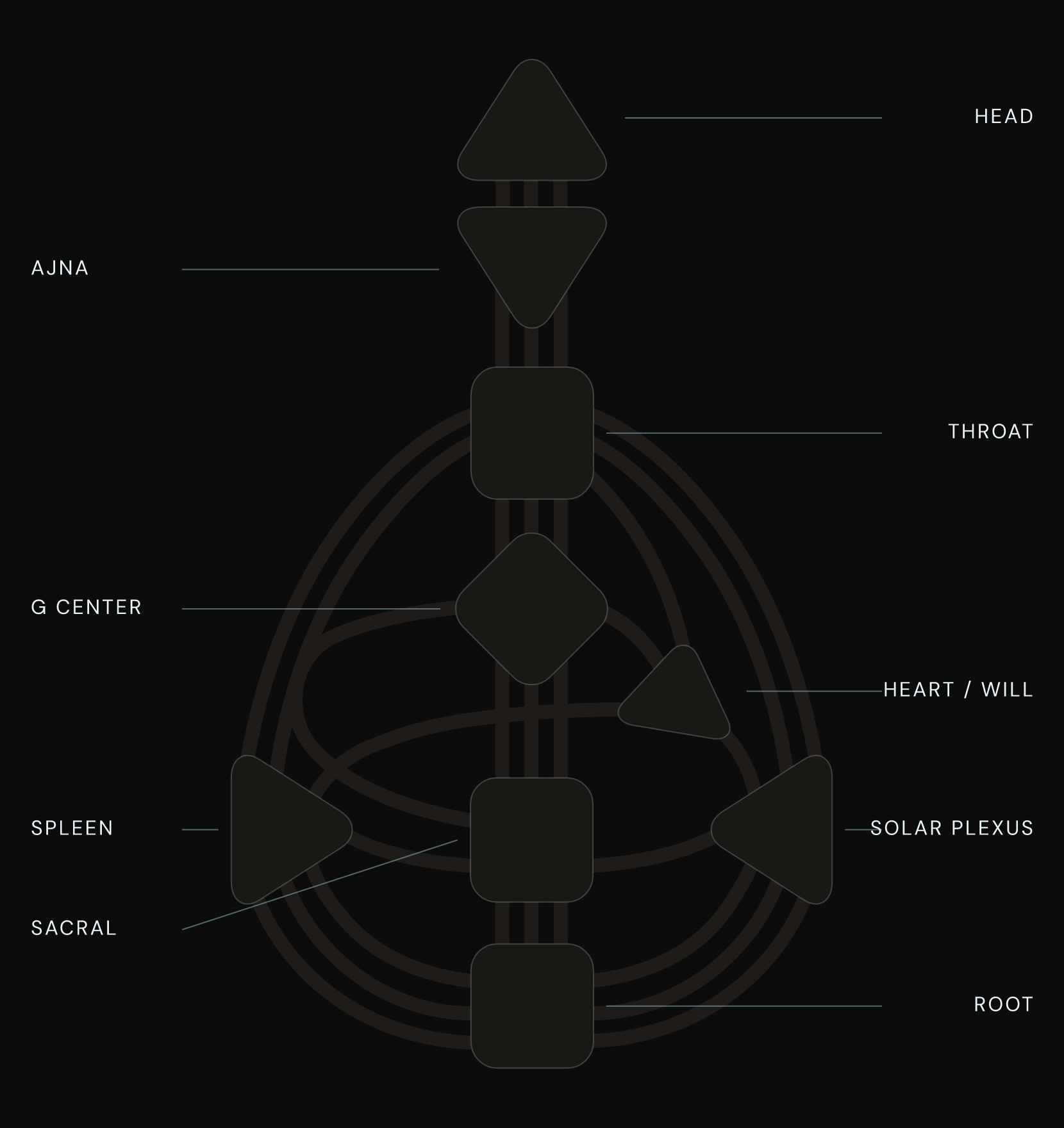
The nine shapes are the centers, the landmarks of the map. Each one governs a function you already know from the inside:
- Head, at the top: the pressure to think. Questions, inspiration, the "why" that shows up at 2am.
- Ajna: making sense of things. Ideas, opinions, and the drive to be certain.
- Throat: communication and action. Everything in the chart is trying to reach the Throat to be said or done.
- G Center, the diamond in the middle: identity, love, and direction. The sense of who you are and where you are heading.
- Heart: willpower and promises. Deals, commitments, and the self-esteem that rides on keeping them.
- Solar Plexus: emotions. Feelings that move in waves, from hope through to disappointment and back.
- Sacral: life force. The renewable energy for work, and the gut response that answers before words arrive.
- Spleen: instinct. In-the-moment body intelligence, the quiet first ping of "safe" or "off".
- Root, at the bottom: pressure again, this time to act. Adrenaline, drive, the push to get things done and be free of them.
A loose grouping helps these stick. Head and Root are pressure centers, one pressing you to think, the other to move. Ajna, Spleen, and Solar Plexus are awareness centers: mental, physical, emotional. Heart, Sacral, Solar Plexus, and Root are motors, the energy supplies of the system. And the Throat stands alone as the outlet, the place where energy becomes words and action.
You do not need to memorize the list. You need to recognize the landmarks, the way you know your own neighborhood before you know the whole city.
Colored or white: defined versus open
Now look at your own chart. Some centers are filled with color. Some are white. This is the most important distinction on the whole page.
A defined center is colored in. That function runs consistently in you, the same whether the room is full or empty. A defined Sacral generates work energy day after day. A defined Solar Plexus feels its own emotional wave, whoever is in the room.
An open center is white. That function is not fixed in you. It is receptive: it takes in and amplifies whatever the room brings. With an open Solar Plexus, you can feel the tension of a meeting more strongly than the person who generated it, and carry it home as if it were yours.
Neither is better. Defined is reliable. Open is receptive, and over time it is where your sharpest wisdom about other people develops. But open centers are also where you absorb pressure and moods that were never yours, which changes how you read your own bad days.
Count your colored centers and you have already read the first layer of your chart. The deeper question, what each center means when defined and when open, gets a full guide of its own in the nine centers.
The 64 gates: fixed addresses, some of them live
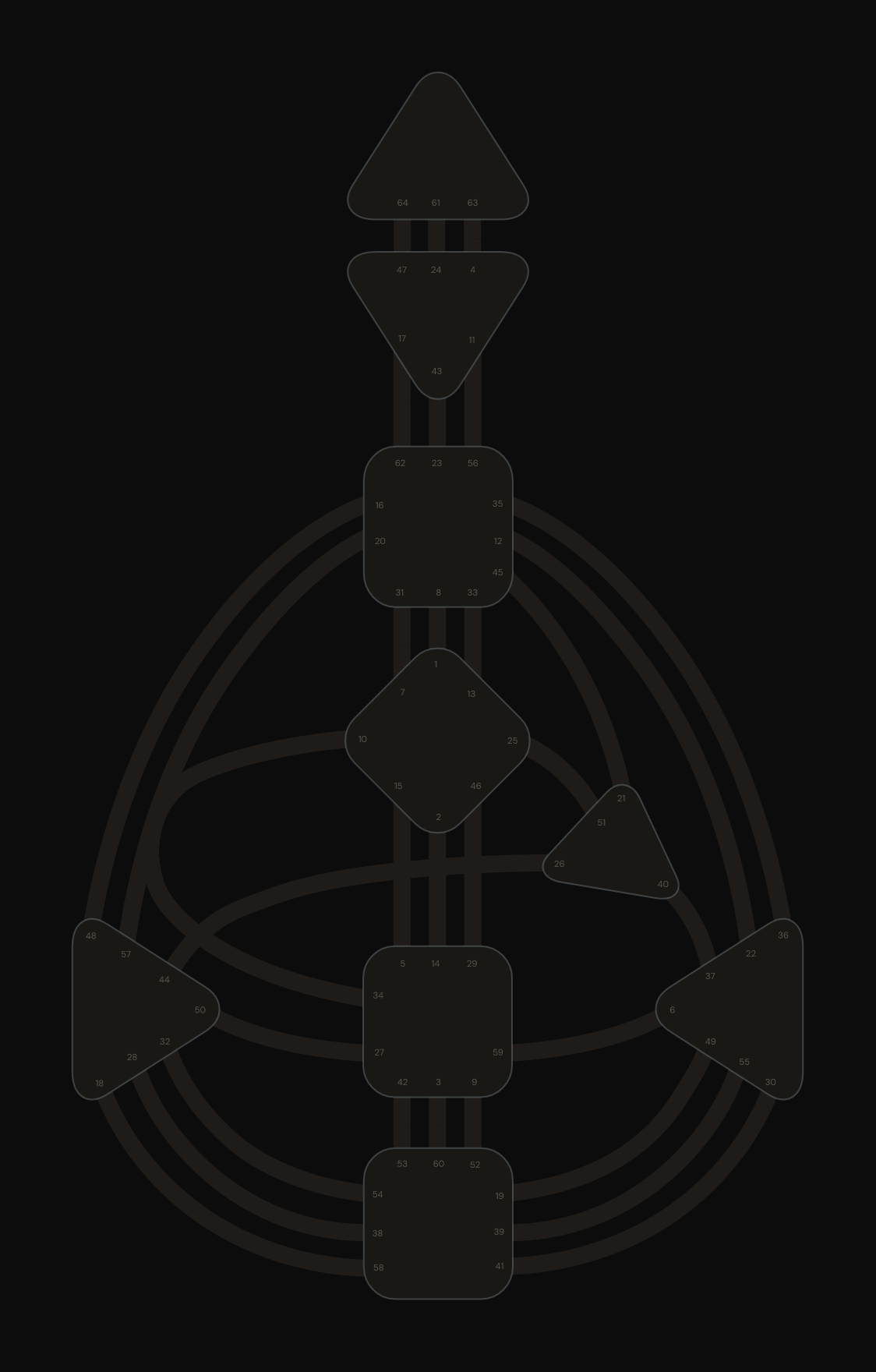
Every small number printed on the bodygraph is a gate. There are 64 of them, one for each hexagram of the I Ching, and each has a fixed address: the same gate sits in the same spot of the same center on every chart ever drawn. Gate 34 is always in the Sacral. Gate 61 is always in the Head.
Each gate is a specific theme of energy. Your birth data activates some of them, and in the render an activated gate lights up its own short stretch of the line it sits on.
An activated gate whose line goes no further is called a hanging gate. It is real energy, but it is half a connection, and it waits for its other half. When you meet someone whose chart carries the matching gate, the connection completes between you, and that meeting has a charge to it. This is one honest reason some people feel instantly magnetic to you: your wiring met its missing half.
Channels: where definition comes from
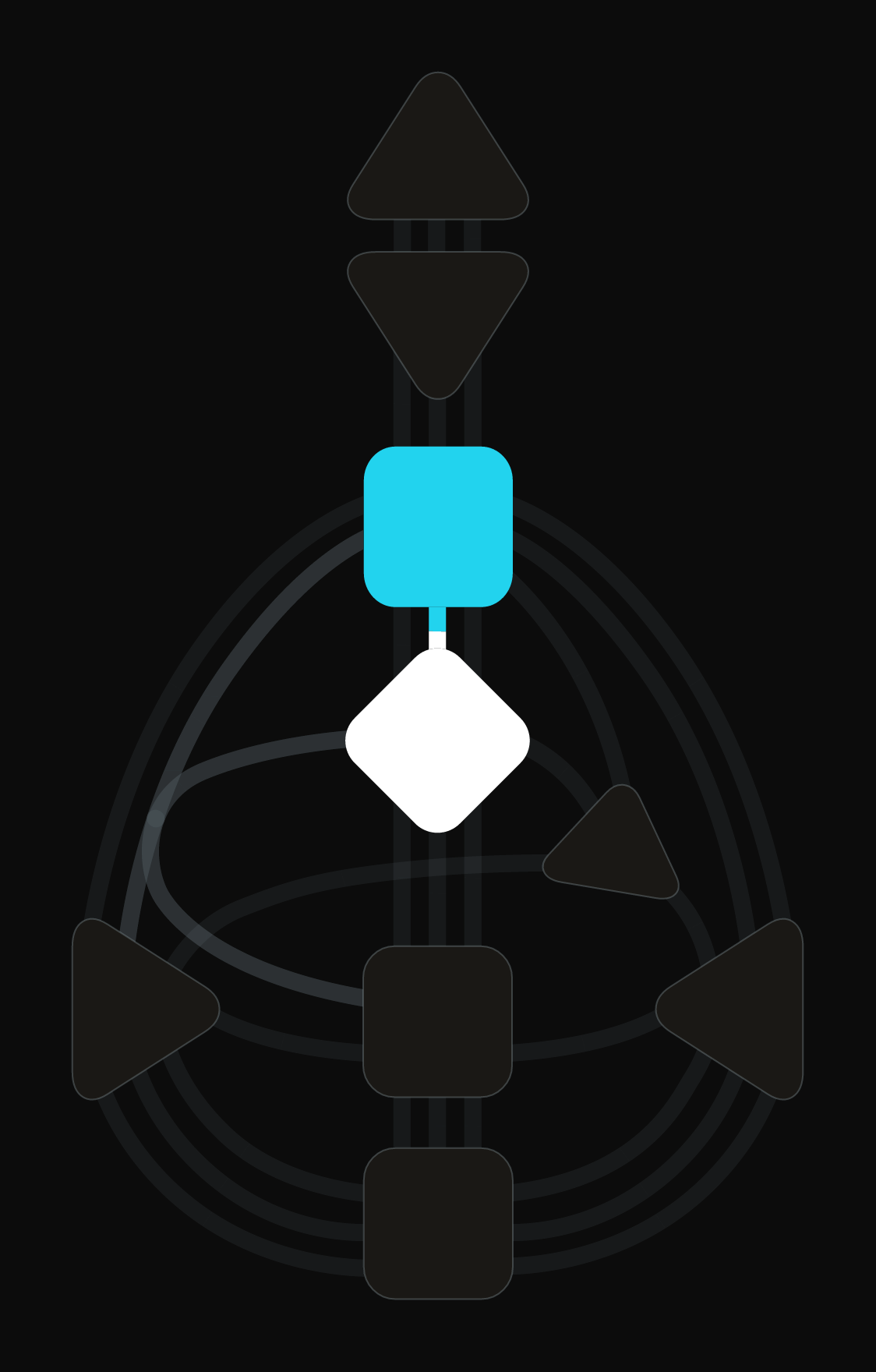
When the gates at both ends of a line are activated, the whole line lights up. That is a channel, and it is the quiet engine of the entire chart, because a defined channel defines both centers it connects.
Centers do not color themselves in. Every defined center in your bodygraph is defined because at least one complete channel plugs into it. Trace any colored center back along its lit lines and you will find the channel that switched it on.
A channel is also more than its two gates added together. Each of the 36 channels carries a distinct quality of energy that runs consistently in you, a frequency you carry steadily. You do not need to learn all 36 today. You need the mechanic: gate plus gate makes a channel, and a channel defines two centers. That one rule explains almost everything colored on the page.
The two columns: Personality and Design
That leaves the two columns of numbers flanking the figure. Each column lists thirteen planetary positions, Sun down to Pluto, with a gate number beside each one. These columns are where every activation in your chart comes from.
The chart is calculated twice. Once for the exact moment you were born: that is your Personality, the conscious side, the part of yourself you recognize when you read about it. And once for roughly three months before your birth, 88 degrees of the Sun's arc earlier: that is your Design, the unconscious side, the part other people notice in you before you do.
In the Aquarius app, Personality activations render in cyan and Design activations in white. Other sites draw the same two columns in black for Personality and red for Design. Same data, different ink. If a gate number appears in both columns, that theme is doubly activated and runs deep in you.
One more useful weighting: the Sun and Earth together account for roughly 70 percent of the chart's influence, which is why the top rows of each column matter most. You do not need to interpret planets today. You only need to know what the columns are: two snapshots, conscious and unconscious, feeding one diagram.
Practical takeaway
When your own chart feels like too much detail at once, the practice is to read it in one order: centers first, then gates, then channels, then the two columns. Each layer explains the next one. Trying to take in every number at the same time is what makes a bodygraph feel unreadable, not the number of parts on the page.
Read your own chart in five moves
Time to test all of this against the real thing. Open your real bodygraph and walk through it:
- Count the colors. Which centers are defined, which are white? That is your reliable energy versus your receptive surface.
- Find your channels. Look for fully lit lines. Each one is a consistent strength you carry into every room.
- Spot a hanging gate. Find a lit half-line and notice which center it reaches toward. That is energy in you that comes alive around certain people.
- Read the columns. Cyan is your conscious Personality, white is your unconscious Design. Glance at the two Sun gates first, they carry the most weight.
- Connect it back. Your defined centers and channels are the mechanical reason you have the Type, Strategy, and Authority you have been experimenting with since the earlier guides.
That is bodygraph literacy. Centers, colors, gates, channels, columns. Nothing on the page is mystery ink anymore, it is just detail you have not read yet.
Frequently asked questions
How do I find my Human Design chart?
Enter your birth date, exact time, and city into a chart calculator. You can generate your free chart here in about ten seconds and keep it forever. You get the full rendered bodygraph plus a plain-language summary of your Type, Strategy, and Authority.
Do I need my exact birth time?
For an accurate bodygraph, yes. Some planetary positions shift gate within hours, so the pattern of activations, and with it your Type and Authority, can change with the time of day. Use the time on your birth certificate if you can. Without it, you still get a useful chart, but treat the time-sensitive details as provisional.
What do the colors on the chart mean?
There are two color systems on one page. Center fill: a colored center is defined and works consistently in you, a white center is open and takes in the energy around it. Activation ink: in the Aquarius app, cyan marks your conscious Personality and white marks your unconscious Design. Many other sites use black and red for the same two calculations.
What is the difference between a gate and a channel?
A gate is one of 64 fixed energy themes on the bodygraph, and on its own it is half a connection. A channel is the complete line, formed only when the gates at both ends are activated. The difference matters because a channel defines the two centers it connects, and definition is what colors your chart in.
Previous in the series: Strategy and Authority. Next: The Nine Centers.